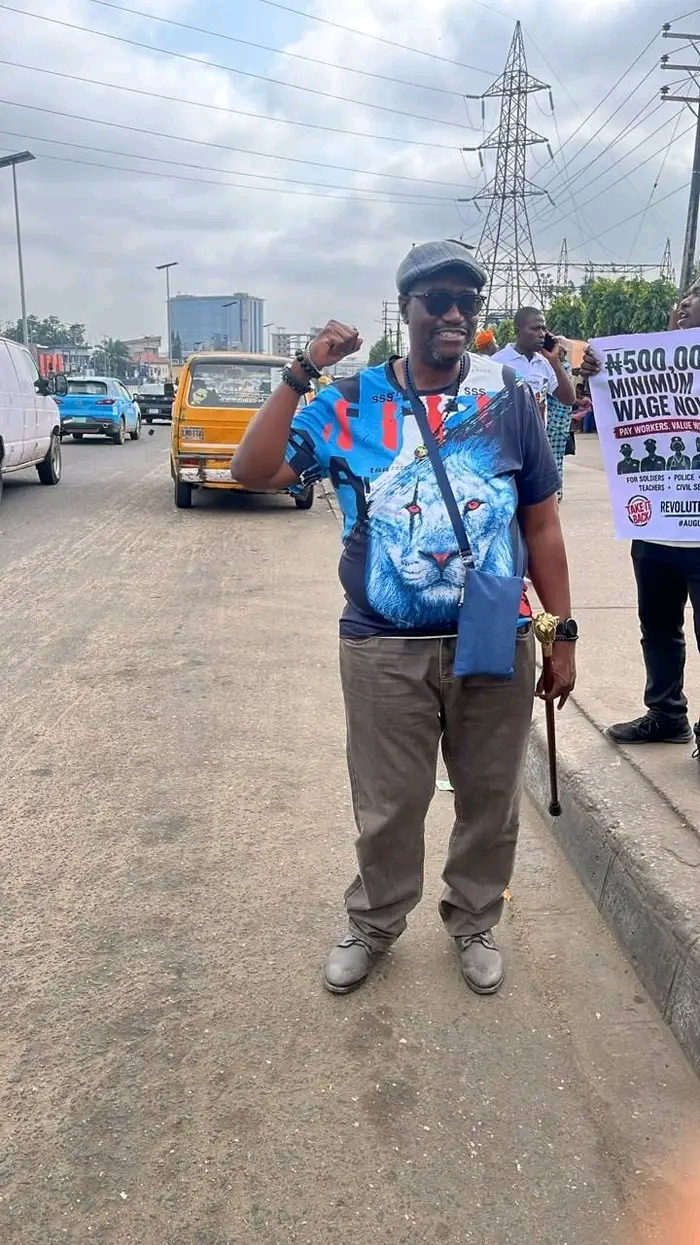
Yesterday, the African Action Congress (AAC) marked the seventh anniversary of its kicking-off the #RevolutionNow campaign with a nationwide series of peaceful protests, which held in five of Nigeria’s six geopolitical zones. The reactionary forces that confronted party activists this time included a range of non-state actors in tacit collaboration with the police.
Back in 2019, the opening #DaysOfRage swept through 23 cities despite the Nigerian state’s effort to thwart it by arresting Omoyele Sowore, the National Chair of the revolutionary part.
“Combined forces of anti-riot police (MOPOL), Special Anti-Robbery Squad (SARS), soldiers, air force personnel, the Department of State Services (DSS) and paramilitary forces like the NSCDC” took over the streets. But that did not stop the revolutionary activists. They showed refusing to be cowed. Thirty-teo of them were brutalise by the security personnel. One was shot in the leg and at least fifty-five were arrested.
Since then, AAC and the Take It Back movement from which it emerged have been at the heart of protest politics for power in Nigeria. It has consistently organised #RevolutionNow demonstrations on 5 August and several other street protests against the people’s hardship, insecurity, bad governance, police brutality, workers’ rights violation, commercialisation of education, crazy electricity poverty and other issues of concern to the poor working people.
The State’s Response: Same Old Playbook, With a Twist
Fast forward to this year, and the state’s reaction feels familiar—almost routine. In Port Harcourt, protesters barely got started before being scattered with volleys of teargas . Police presence was heavy in all the theatres of action. But here’s the thing: there was a new wrinkle. Instead of just uniformed officers, the ruling party rolled out mobilized supporters, paid hirelings and thugs. In Lagos and Abuja, the epicenters of the protest, pro-state demonstrators squared off against the #RevolutionNow AAC activists.
Lagos: attack by thugs in Maryland
Lagos was especially tense. The political capital of Nigeria’s working people saw a mix of APC supporters, armed thugs, and police working in tandem to shut down the protest. AAC members gathered at Maryland, planning to march to the Freedom Square at Ojota. By 8:30, scores had arrived, only to find a large number of armed police blocking their path. They assembled in a new by street and moved to the rally site in their numbers, by 9:30am. The lead police officer approached them called for a peaceful protest. The organizers replied, “That’s exactly what we’re here for.” You would think that would settle things if you really believe the police is our friend. but – hardly surprisingly – within 45 minutes, the mood shifted.
Solidarity songs filled the air as more activists arrived. Suddenly, the police moved from the left side of the demonstrators where they had been to ensure traffic flow, to the right. And, almost on cue, about two dozen thugs stormed through, armed with iron rods and shouting, “Tinubu forever!” They tore banners, grabbed placards and attacked AAC members as well as some journalists.
The revolutionary activists stood their ground despite threats to their lives. The police then fired several rounds of tear gas canisters into the protest and surrounding areas.
Paid Crowds, Thugs, and an Act of Suppression
Earlier that morning, a pro-Tinubu crowd of around 200 people with branded T-shirts gathered at Ikeja Roundabout, a traditional protest hotspot. They marched to Maryland, taking over the rally ground under police protection after tear gas had cleared in the area.
In Abuja, paid hirelings carried placards calling for the criminalization of activism, describing activists as “subversive elements” and justifying the Tinubu-led APC’s policies. This is a trend that must be of concern to the working people and all progressive forces committed to the struggle for liberation from the hands of the exploiters who rule over us. The state is not just using force or pro-government “protesters”. It is trying to manufacture some form of consent by blending paid crowds with muscle to drown out dissent.
This trend is not new, but it is evolving. The mobilization of thugs on one hand and a questionable base of supporters on the other have long been features of the Nigerian ruling class’ politics. Sometimes, it is about attacking opponents; other times, it’s about creating the illusion of popular support for unpopular governments. Now, both tactics are being woven together, and the fabric is getting thicker.
Historical Threads: From Pre-Independence to #EndSARS
This is not just about yesterday’s protests. There is a history here which stretches to when the three main power Blocs of the ruling class locked horns for power on the eve of Independence. Each of them – in the Eastern, Northern & Western regions – had their bands of thugs to harass and intimidate political opponents.
Thugs were mainly ingredients for civilian governments extra-state violence. The military junta had little need for them. In fact, “Area Boys” in Lagos joined the pro-democractic fightback after the annulent of the June 12 presidential election in 1993, boldly putting their lives and liberty on the line.
Paid crowds & contrived masquerades of support were more useful for the military dictators during their rule, especially in the 1990s. These included the range of callers for Abacha to succeed himself. The loudest of these was the Youths Earnestly Ask for Abacha (YEAA).
In the Second Republic, the NURTW emerged as an institutional body for thuggery, beyond its defined role as the National Union of Road Transport Workers. Its stalwarts like Bayo Success in Lagos and Busari Adelakun in Ibadan, who were anything but workers, were major enforcers for ruling parties. Fast forward to the 21st century, we saw the central role that Tokyo played as the right hand of Lamidi Adedibu in Ibadan. And for a while now, MC Oluomo has been the overlord of thuggish support for Bola Tinubu and his parties (ACN to APC) in Lagos. These fascistic bands of armed street fighters have not just been election tools as they were in the 20th century. They are now used to attack protesters too.
In May 2016, a band of thugs attacked workers protesting the first fuel price hike under General Muhammadu Buhari (RETD), shouting “Sai Baba!” and hurling stones. During the EndSARS Rebellion, armed thugs tried to break up protests at the Lagos State House of Assembly as the revolt deepened, but the masses pushed back.
During the 2023 elections, after APC lost Lagos in the presidential vote, thugs were mobilized to intimidate voters ahead of the gubernatorial elections. Ethnic identities were stirred up, too.
The ruling class and particularly APC which world’s state power is casting a messy, tangled web of violence, mobilisation of ethnic identity and a largely contrived massified support on the streets. But, their policies, programmes & exploitative system are sowing seeds of genuine mass discontent and simmering anger as we saw with the waves of strikes and mass protests in 2024-2925. And this is not going away anytime soon.
Economic Hardship and the Politics of Resistance
The hardship poor working people face today is not just a side effect or a passing thing—it is baked into the system. The APC regime’s economic policies are designed to benefit the rich, and the rich are getting richer. Even international financial institutions, usually cheerleaders for these policies, admit things are likely to get worse for our class – we the exploited masses. That is bound to spark resistance. Mass discontent will spill onto the streets, and reactionary forces—thugs, paid crowds, “non-state actors”—will be there to meet it.
The Nigerian state keeps denying the existence of hunger, but as resistance grows, it won’t just stand by. And resist we must. But here’s the contradiction: this reactionary politics isn’t a sign of strength. It’s a sign of weakness. The ruling class’s legitimacy is crumbling. State force alone won’t keep them in power. Brute force and fascistic confrontation are desperate measures. And they have limits which we can force on them and smash the system they are made to defend.
Reactionary Politics: Weakness Disguised as Strength
Yesterday, poor petty traders near the rally called on the leader of the thugs, Pepe, to let the protesters be. Most fled, wares overturned, when tear gas rained down. There’s a lesson here—EndSARS showed that the masses, when united, can repel thugs. Similarly they could not be mobilised against the masses on the streets during the #OccupyNigeria 2012 January Uprising. And in states like Bayelsa where they roved the streets to stop protests, they could not stop workers from downing their tools as part of the nationwide general strike.
But those numbers don’t just appear out of thin air. Spontaneous resistance needs a spark, and that spark comes from organizing—a revolutionary party, a coalition: as the bedrock of organization for revolt, for revolution.
Lessons from the Streets: Spontaneity vs. Organization
Two examples stick out. The Campaign for Democracy, a coalition of the left, organized protests between 1991 and 1993, never drawing more than a few dozen people. But their coalition provided crucial leadership in the early days of the June 12 struggle.
The EndSARS spark was the African Action Congress. It had organized a series of protests for over a year, the last being a few days before EndSARS started. It was also the force calling people to rise against SARS and police brutality once again, after the 4 October reports of police killing a young man at Ughelli. Several tweets by Omoyele Sowore and his leadership of the first action within that rebellion—a march to the police headquarters in Abuja—attest to this
Without organization, resistance fizzles. To defeat reactionary forces, the ruling class and the movement they represent, we need a movement—a force on the ground, built from the bottom up.
The Role of the African Action Congress
The AAC’s #RevolutionNow campaign is about building that force on the streers. It’s also the only political party representing the interests, yearnings, and aspirations of Nigeria’s working masses for decent lives, dignity and respect on the ballot.
It’s goal is to provide leadership for exploited, oppressed and repressed masses in struggle to end economic hardship, stop political suppression, enthrone peace and security based on justice, and achieve total liberation. It’s a tall order. But we can win together. The struggle continues.
Conclusion: The Struggle Continues
So, what’s next? The events of yesterday aren’t just a footnote—they’re a sign of what’s to come. As 2027 approaches, the threads of paid crowds, thugs, and economic hardship are being woven tighter. But the people aren’t powerless. Organization, solidarity, and persistence are the keys. The struggle continues, and, honestly, it’s not just about politics—it’s about the soul of Nigeria.
Bàbá Ayé
6 Aug., 2026
Leave a Reply