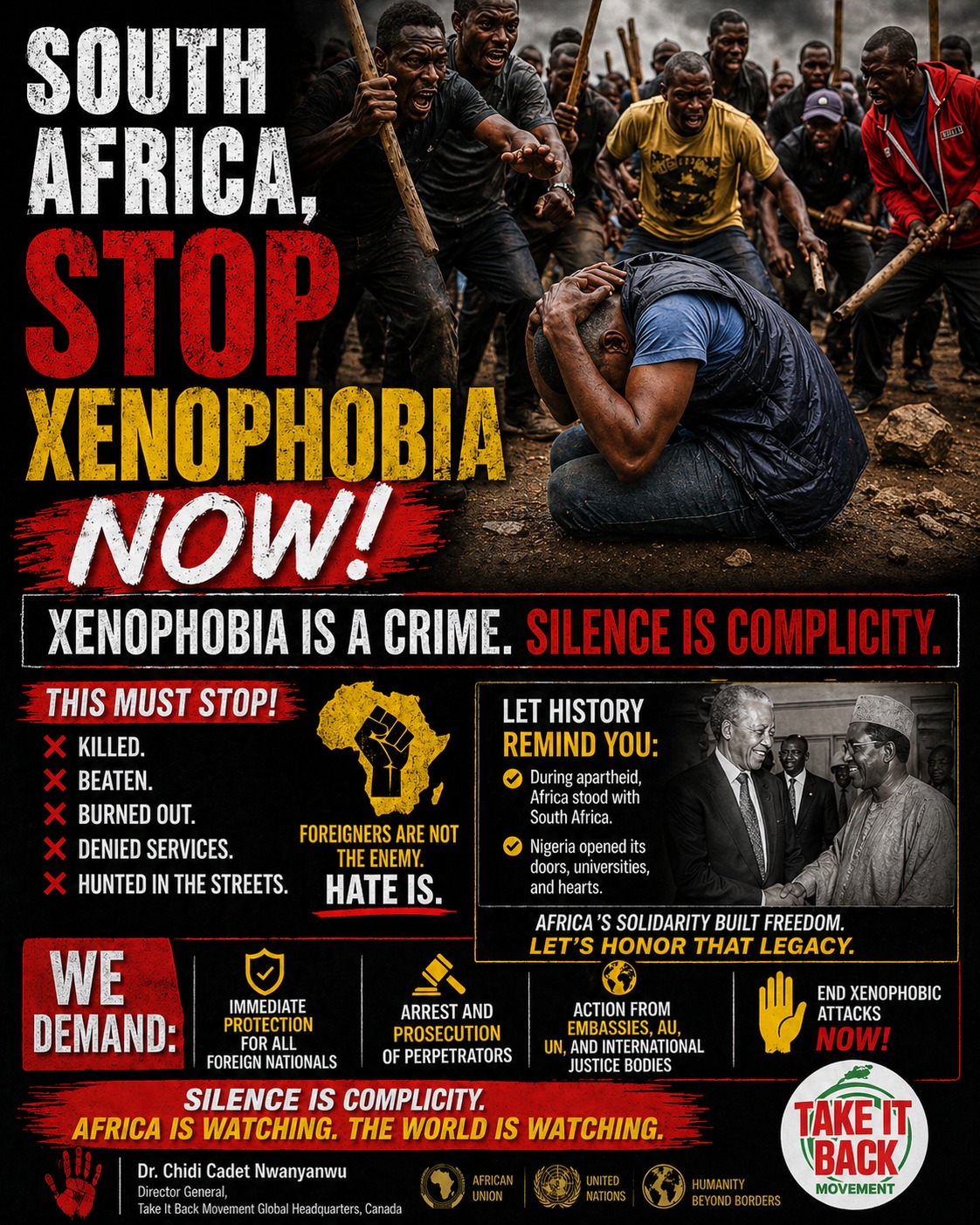
PRESS STATEMENT
FOR IMMEDIATE RELEASE
A CONDEMNATION IN THE STRONGEST TERMS OF THE RENEWED XENOPHOBIC ATTACKS AGAINST AFRICAN FOREIGN NATIONALS IN SOUTH AFRICA
Dear Africans, the Take It Back Movement condemns in the strongest possible terms the renewed wave of xenophobic intimidation, harassment, humiliation, denial of services, and violence being directed at foreign nationals in South Africa, particularly fellow Africans, including Nigerians, Ghanaians, Zimbabweans, and other migrants who live, work, study, trade, and seek medical care in the country.
Recent reports have shown disturbing acts of anti-foreigner hostility, including cases of foreign nationals being harassed and told to leave South Africa, and anti-migrant groups such as Operation Dudula reportedly blocking migrants from accessing public health facilities and other basic services. South African authorities have publicly promised to crack down on xenophobic attacks after Ghana summoned South Africa’s envoy over viral videos showing violence and intimidation against Ghanaians and other foreign nationals.
Let it be clear: this is not ordinary politics. This is not patriotism. This is not community protection. This is xenophobia. It is racism turned inward against fellow Africans. It is a betrayal of African solidarity, a betrayal of the struggle against apartheid, and a betrayal of the memory of Nelson Mandela, Oliver Tambo, Walter Sisulu, Chris Hani, Desmond Tutu, and countless others who stood for human dignity.
South Africa must never forget that when apartheid brutalized Black South Africans, Africa stood with South Africa. Nigeria stood with South Africa. Nigerians contributed politically, diplomatically, financially, morally, and personally to the liberation struggle. Nigeria was at the forefront of anti-apartheid sanctions, boycotts, diplomatic pressure, and liberation solidarity. Historical accounts record Nigeria’s central role in the decolonization and anti-apartheid struggle, including its persistent support for oppressed Black South Africans and pressure for embargoes, boycotts, and sanctions against apartheid South Africa.
This is not history I was merely told. I lived close enough to that history. I was in the Department of Architecture at the University of Nigeria, Nsukka, with South African students and members connected to the African National Congress, Mandela’s party, who had found refuge, education, and solidarity in Nigeria while apartheid denied them freedom at home.
Nigeria did not ask them whether they were South African before treating them as Africans. Nigeria did not deny them classrooms. Nigeria did not chase them out of hospitals. Nigeria did not tell them to go back home to oppression. Nigeria opened doors.
It is therefore painful, shameful, and unacceptable that today, some Black South Africans now turn around to humiliate, threaten, attack, and dehumanize other Africans on South African soil.
We acknowledge that South Africa faces real economic hardship, unemployment, crime, poverty, and pressure on public services. But no honest society solves those problems by scapegoating the vulnerable. Foreign nationals did not create apartheid. Foreign nationals did not loot South Africa’s public institutions. Foreign nationals did not create unemployment, corruption, inequality, or state failure. Political leaders and state institutions must not use migrants as convenient sacrifices for their own failures.
I therefore call on:
- The Government of South Africa
To immediately protect all foreign nationals within its borders, arrest and prosecute those inciting or carrying out xenophobic harassment and violence, and ensure that no vigilante group is allowed to usurp the role of the state. - The South African Police Service
To act visibly, urgently, and without bias against all individuals and groups threatening migrants, blocking access to hospitals, intimidating business owners, or inciting violence online and offline. - The Nigerian Government and Nigerian High Commission in South Africa
To urgently document all attacks, provide consular protection, issue clear public advisories, demand accountability from Pretoria, and ensure that Nigerian lives and businesses are not treated as disposable. - All African Embassies in South Africa
To act collectively, not separately. This is not only a Nigerian problem, a Ghanaian problem, or a Zimbabwean problem. It is an African problem. African embassies must jointly demand protection, restitution, prosecution, and guarantees of non-repetition. - The African Union
To treat this as a continental human-rights emergency. The AU cannot preach African unity while Africans are hunted, humiliated, or denied services in another African country. - The United Nations and relevant international human-rights bodies
To monitor, investigate, and speak clearly against xenophobic violence and state failure to protect migrants and refugees. - The International Court and international justice mechanisms
Where state failure, organized persecution, or systematic abuse can be legally established, all available international mechanisms must be explored. No country should be allowed to look away while vulnerable people are targeted because of nationality.
To the people of South Africa, I say this with pain and seriousness: the world is watching. Africa is watching. History is watching. The same continent that stood with you in your darkest hour cannot now be repaid with hatred, stones, threats, humiliation, and blood.
We demand an immediate end to xenophobic harassment and violence in South Africa.
We demand protection for Nigerians and all foreign nationals.
We demand prosecution of perpetrators and sponsors.
We demand public condemnation from responsible South African leaders.
We demand compensation and justice for victims.
We demand that South Africa choose the legacy of Mandela over the poison of mob hatred.
Africa must not become a continent where Black people escape racism abroad only to be attacked by Black people at home.
This must stop now.
Failure to stop it must carry consequences — diplomatic, legal, political, and international.
Signed,
Dr. Chidi Cadet Nwanyanwu
Director General
Take It Back Movement Global Headquarters
Date: April 28, 2026
Leave a Reply