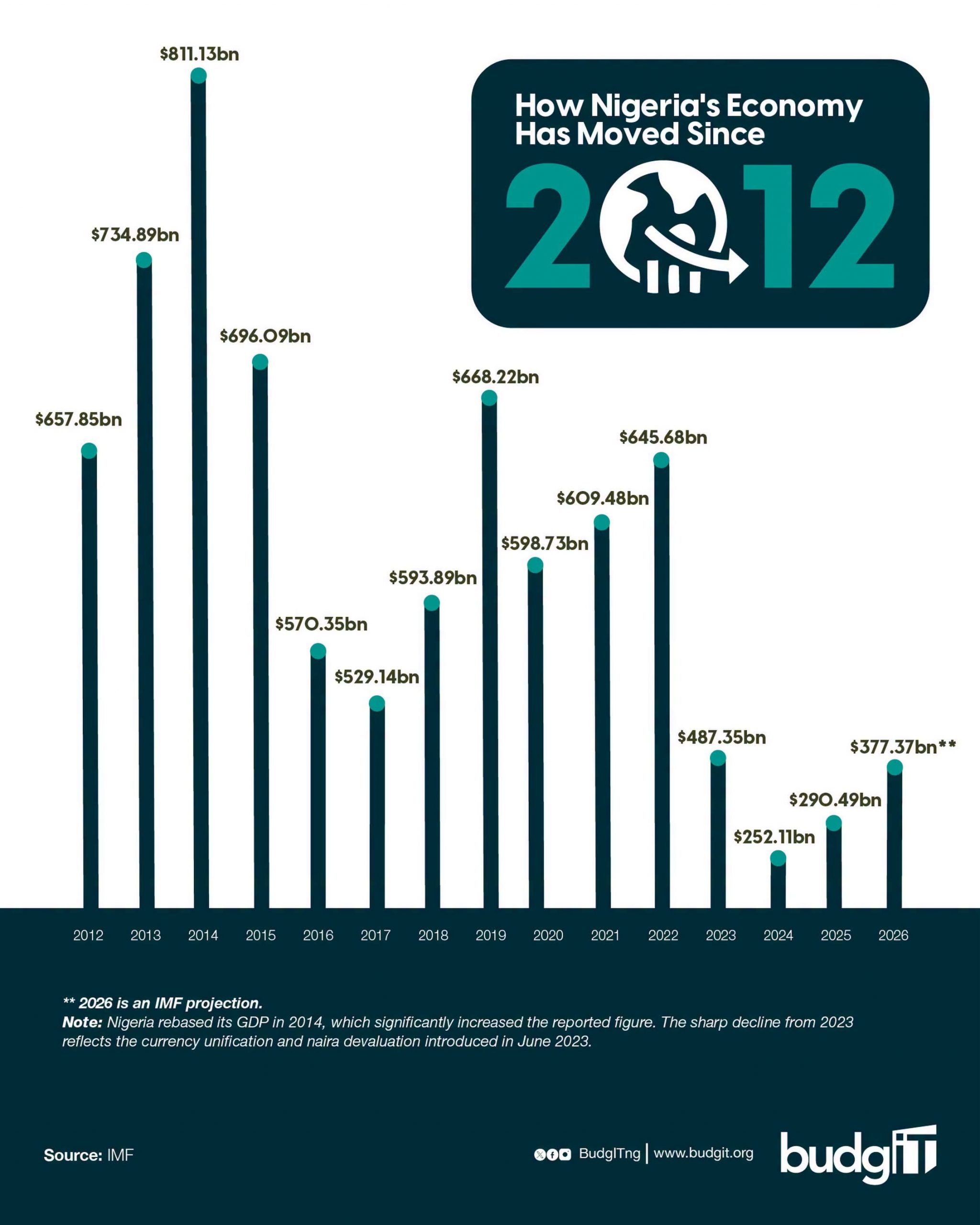
Nigeria’s nominal Gross Domestic Product (GDP) has fallen to less than half of its 2022 value following the economic reforms introduced under President Bola Tinubu’s administration, according to a new pictorial report released by civic technology organisation BudgIT.
In the infographic shared on Monday across its social media platforms, BudgIT showed that Nigeria’s nominal GDP declined from $645.68 billion in 2022 to $252.11 billion in 2024, before recovering slightly to $290.49 billion in 2025.
Explaining the figures, BudgIT stated: “Between 2022 and 2024, under the Tinubu administration and following the move to a floating exchange rate, nominal GDP fell from $645.68bn to $252.11bn in just two years.”
According to the organisation, Nigeria recorded its highest nominal GDP in 2014, when the economy was valued at $811.13 billion after the country’s GDP rebasing exercise, “Nigeria’s economy reached a record high of $811.13bn in 2014 after GDP rebasing, briefly making Nigeria Africa’s largest economy,” BudgIT said.
The report noted that the gains did not last, as declining global oil prices and exchange rate pressures pushed the country’s GDP down to $529.14 billion by 2017. BudgIT explained that the economy later recovered, rising steadily to $645.68 billion in 2022, before the sharp decline that followed the introduction of the floating exchange rate and the naira devaluation in June 2023.
The infographic also showed signs of a modest rebound, with Nigeria’s GDP increasing to $290.49 billion in 2025. Quoting projections by the International Monetary Fund (IMF), BudgIT said the country’s nominal GDP is expected to rise further to $377.37 billion in 2026. Despite the projected increase, the organisation noted that the economy would still be far below its 2014 peak in dollar terms.
BudgIT, however, cautioned against interpreting the figures as a complete measure of economic performance, “It’s important to remember that these are nominal GDP figures. That means much of the movement reflects changes in the exchange rate, not necessarily changes in the actual size of the economy,” the organisation stated.
It further stressed that improvements in economic indicators must translate into better living conditions for ordinary Nigerians, “The numbers may be improving, but economic recovery means little if Nigerians don’t feel it in their everyday lives,” BudgIT added.
Leave a Reply