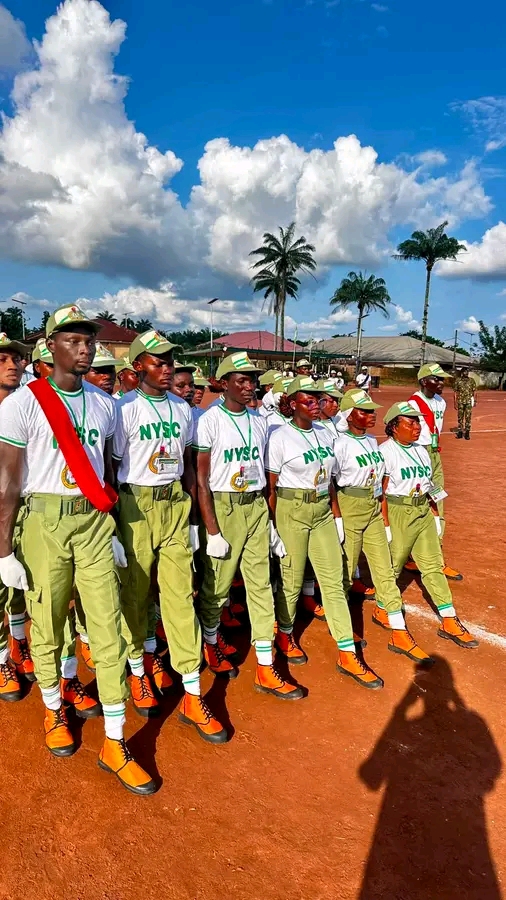
When the Director-General of the National Youth Service Corps, Brigadier General Olakunle Nafiu, warned corps members in Katsina against campaigning for political parties or candidates on social media and threatened that “appropriate action” would be taken against offenders, he raised an important constitutional question:
How far can the NYSC go in restricting the political expression of young Nigerians during their service year?
Speaking to the 2026 Batch ‘B’ Stream II corps members at the NYSC Permanent Orientation Camp in Katsina, Nafiu said:
“As corps members, you are not permitted to campaign for any political party or candidate. If your social media activities are traced to political promotion while wearing the NYSC identity, appropriate action will be taken.”
The warning deserves serious public discussion.
Not because the NYSC has no rules on partisan politics. It does. The NYSC bye-laws state that corps members must not take part in partisan politics and provide for an extension of service of at least three months without pay for a member who violates the provision.
But that is where the real question begins.
What exactly amounts to “partisan politics”?
Does it include campaigning for a candidate while acting in an official NYSC capacity? Clearly, the NYSC has a strong argument for restricting that.
But does it also mean that a young Nigerian loses the constitutional right to express a political opinion on a personal social-media account simply because he or she is serving in the NYSC?
That question cannot be answered by a threat of “appropriate action.”
A corps member does not stop being a Nigerian citizen because he or she wears the NYSC uniform.
Section 39 of the 1999 Constitution guarantees freedom of expression, including the freedom to hold opinions and to receive and share ideas and information without interference.
Section 40 also guarantees the right to assemble freely and associate with others, including through lawful political associations.
These rights are fundamental. However, they are not absolute. Section 45 of the Constitution allows certain restrictions on these rights where the restriction is provided by law and is reasonably justifiable in a democratic society, including in the interests of public order, public safety or the protection of the rights of others.
So the debate is not as simple as saying that the NYSC has no power to regulate partisan political activity.
The real issue is whether the particular restriction being enforced is lawful, clear, proportionate and constitutionally justified.
The NYSC bye-laws were not written specifically for today’s social-media environment. Yet the reality today is that social media is part of everyday life. Corps members use X, Facebook, TikTok, Instagram and WhatsApp as private citizens.
Therefore, if the NYSC wants to punish a corps member for a political post, it should be able to clearly explain: What rule was violated? What conduct amounts to partisan politics? Does the rule apply to a corps member’s private account when the person is not acting in an official NYSC capacity? And what legal procedure will be followed before punishment is imposed?
These questions deserve clear answers. A vague threat that “appropriate action” will be taken is not enough.
In 2025, corps member Rita Ushie Uguamaye, popularly known as Raye, attracted national attention after posting a TikTok video in which she complained about economic hardship and criticised the government. Amnesty International later reported that NYSC officials threatened and intimidated her and that the NYSC withheld her discharge certificate and extended her service by two months.
The NYSC’s position was that the disciplinary action was connected to a failure to complete mandatory biometric clearance, while critics argued that her political comments were the real reason for the punishment.
That controversy should have taught the institution an important lesson: when a disciplinary action follows political criticism, the NYSC must be exceptionally clear about the rule that was breached and the evidence supporting the punishment. Otherwise, legitimate disciplinary powers can easily be seen as political intimidation.
There is a legitimate reason for the NYSC to demand political neutrality from serving corps members. Corps members are often involved in election-related duties. The NYSC has also stated that corps members will play an important role as ad hoc personnel during the 2027 elections.
A corps member who is serving as an election official should not use that position to campaign for a political party or candidate. That is understandable. But neutrality in an official role is not necessarily the same thing as silence as a private citizen.
There is a difference between saying: “Do not use your NYSC position to campaign.” and saying: “You cannot express political opinions on your personal social-media account.”
The first is easier to justify. The second requires much more careful legal and constitutional examination. The phrase “appropriate action” is also troubling because it leaves corps members guessing about what punishment they could face. Would it mean an extension of service? Loss of allowances? A disciplinary hearing Withholding of a discharge certificate? Or something else?
The NYSC already has disciplinary rules and procedures. Its bye-laws specify penalties for several forms of misconduct, including partisan politics. Therefore, corps members deserve to know exactly which rule applies and what process will be followed. Discipline should never depend on fear or uncertainty.
This issue should not be left entirely to NYSC management. If there is uncertainty about what corps members can or cannot do politically, lawmakers should examine the legal framework governing the scheme and determine whether it is sufficiently clear for the social-media age. Young Nigerians should not have to guess where their constitutional rights end simply because they are serving their country for one year. And if their rights are being restricted, there must be a clear legal basis for doing so.
The NYSC has a legitimate interest in remaining politically neutral. Corps members should not use the NYSC uniform, office or official position to campaign for political parties or candidates. But that legitimate interest must not become a licence for unlimited control over the private political expression of young Nigerians. The Constitution remains the highest law in the country.
So, DG Nafiu, the question is not simply: “Are corps members allowed to campaign?” The more important questions are: What exactly constitutes campaigning? What law or regulation is being enforced? Does it apply to private political expression on personal social-media accounts? And is that restriction reasonably justifiable under the Constitution?
These questions deserve clear answers—not threats, not assumptions and not vague references to “appropriate action.” Nigeria needs politically aware young people who understand their rights and responsibilities. It also needs credible and politically neutral election officials. The challenge is to protect both. That balance must be guided by the law.
Leave a Reply